Asset Management
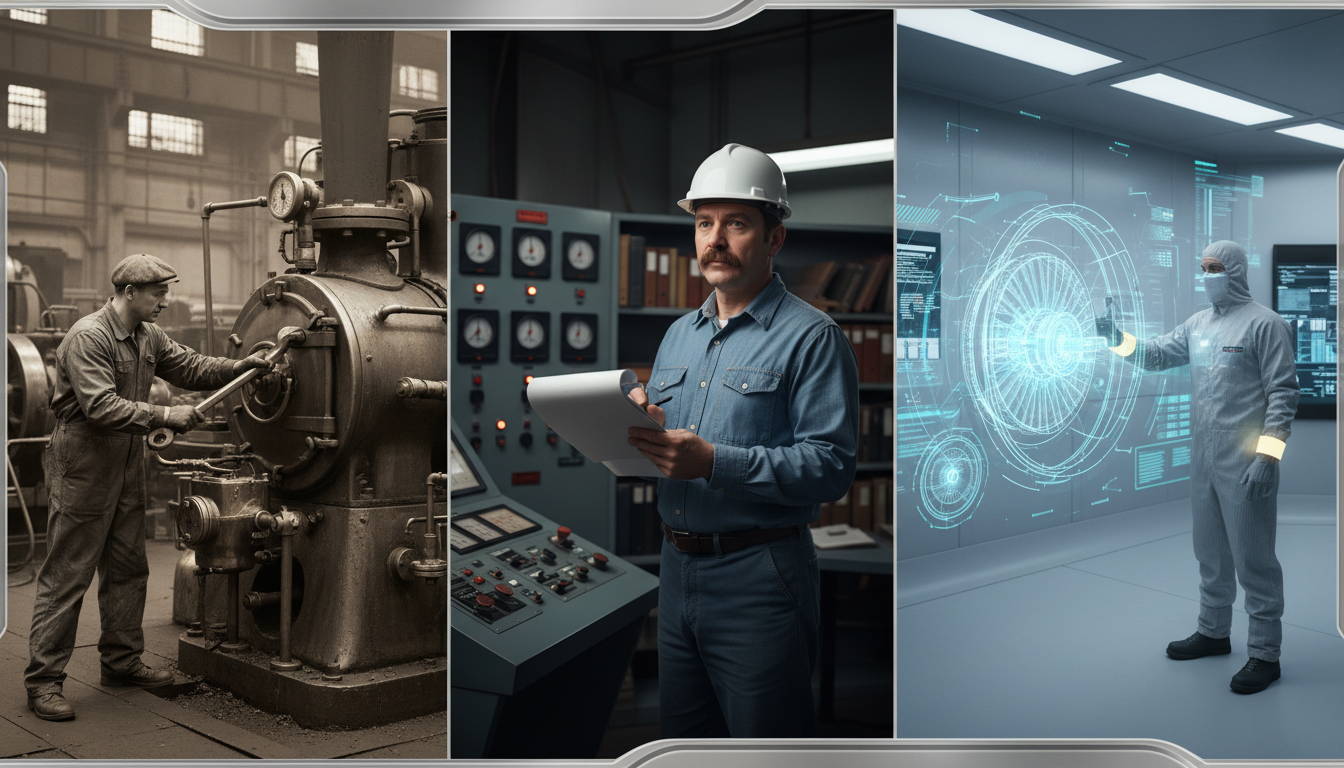
The Evolution of Reliability: Understanding the 4 Generations of Maintenance

How we moved from “fix it when it breaks” to “fixing it before it thinks about breaking.”
Table of Contents
- Generation 1: The Reactive Era (Pre-1950)
- Generation 2: The Preventive Era (1950-1970)
- Generation 3: The Predictive Era (1980-2000)
- Generation 4: The Prescriptive Era (Industry 4.0)
- Comparative Analysis
Maintenance isn’t what it used to be. Over the last eighty years, the philosophy behind keeping assets running has shifted dramatically, driven by rising costs, complexity, and technology.
Generation 1: Reactive Maintenance
Covering the period up to World War II, industry was generally un-mechanized. Machines were simple and over-designed. Downtime wasn’t critical because production demands were lower.
- Motto: “Fix it when it breaks.”
- Strategy: Run-to-failure.
- Tech Level: Basic hand tools.
Generation 2: Preventive Maintenance
Post-WWII mechanized industry drastically. Labor costs rose. We couldn’t afford to wait for breaks. The focus shifted to preventing failures before they occurred through scheduled overhauls.
- Motto: “Fix it on a schedule.”
- Strategy: Calendar-based overhauls.
- Key Concept: The Bathtub Curve (believing mostly in age-related failure).
Generation 3: Condition-Based Maintenance
Starting in the late 70s, research (like the airline industry’s RCM) proved that only 11-18% of failures are age-related. Most are random. This birthed Condition Monitoring.
- Motto: “Fix it when the data says so.”
- Strategy: Reliability Centered Maintenance (RCM), Vibration Analysis, Oil Analysis.
- Shift: Focus on failure modes, not just age.
Generation 4: Prescriptive Maintenance
The current era. We aren’t just predicting failure; systems now prescribe solutions. Utilizing the IIoT (Industrial Internet of Things) and Machine Learning.
“It’s no longer about just avoiding downtime; it’s about optimizing asset value and energy efficiency automatically.”
| Generation | Focus | Data Usage |
|---|---|---|
| Gen 1 | Repair | None (Observation) |
| Gen 2 | Availability | Historical (Time-based) |
| Gen 3 | Reliability | Real-time Sensors |
| Gen 4 | Value & Risk | AI & Big Data |
Share this article Twitter LinkedIn